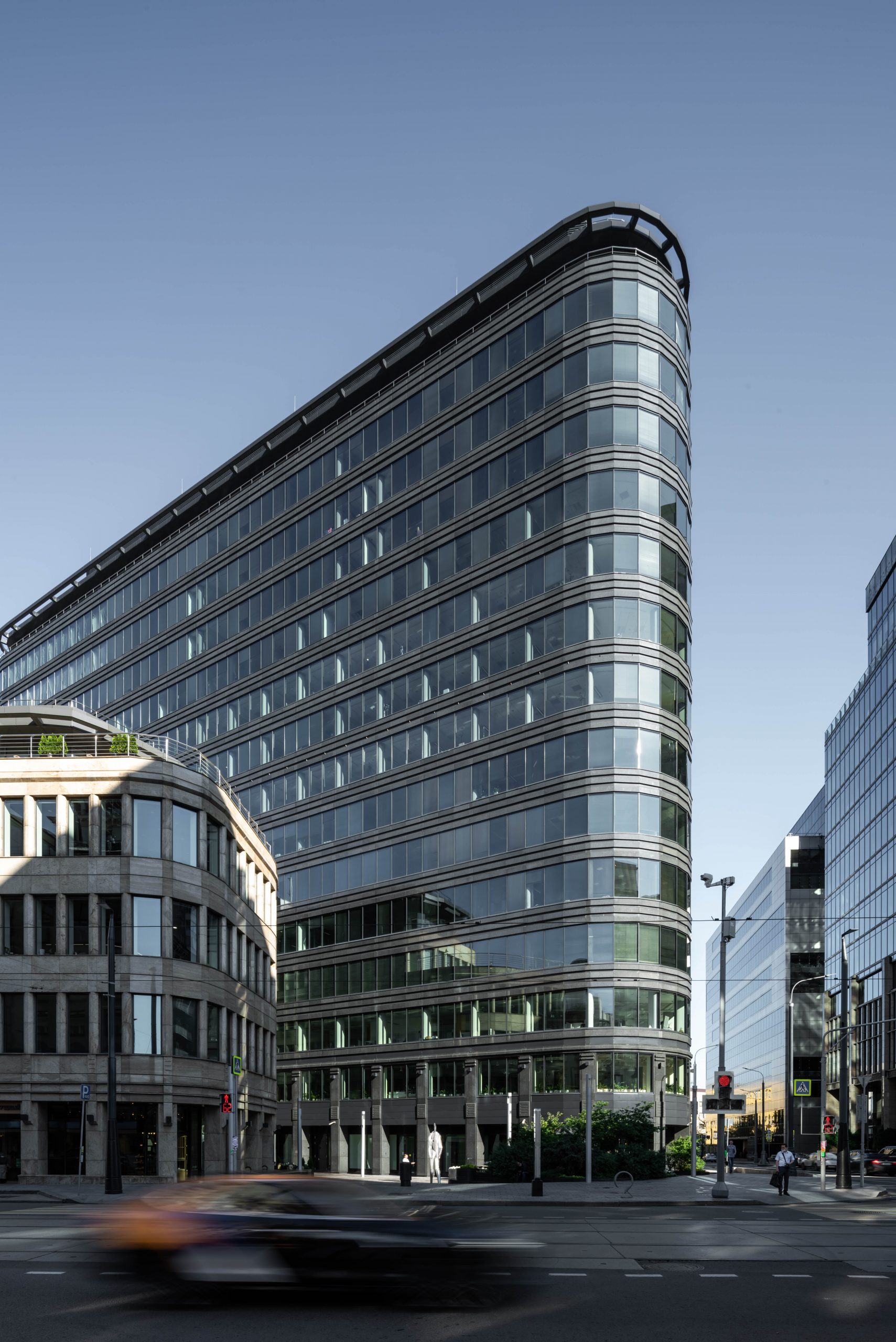
Managing Director of O1 Standard takes part in CRE Mid-Year Results Conference

On July 22, Moscow hosted the Mid-Year Results 2021 conference, which was attended by consultants and leaders of the Russian commercial real estate market. Speakers reviewed results in the first half of 2021 and shared their vision of how the market is likely to develop in the future.

In his speech Dmitry Sveshnikov, Managing Director of O1 Standard, told the conference about recent trends in the property management business, the changing role of management companies, and the importance of good communication with tenants in order to win their trust for anti-COVID measures and the safe return of staff to offices. Dmitry noted growing interest in environmental certification of buildings and offices, which helps to create a comfortable and healthy space for users. To date 12 of the business centres served by O1 Standard have been certified to the BREEAM international environmental standard.

Dmitry also emphasized the importance of IT technologies both for managing and operating buildings, and in order to expand the list of services to tenants.

Managing Director of O1 Standard figures in CRE 100 rating

Dmitry Sveshnikov, Managing Director of O1 Standard, figures in the Property Management section of the most recent CRE 100 rating, which picks out the most influential people in Russia’s commercial real estate business, .

The editors of CRE, Russia’s leading new and analysis portal for real estate professionals, noted that size of the property portfolio under O1 Standard’s management has grown to over 1 million square metres under Dmitry’s leadership, including a recent contract to manage the Skylight business centre and 38 new client agreements.

CRE also cited new directions in work by O1 Standard: consulting at the pre-operation stage, environmental certification and technical audit of facilities. The Company has also worked hard to develop its customer service, resulting in improved tenant satisfaction compared with 2019. Two more properties managed by O1 Standard have successfully passed BREEAM certification, increasing to 12 the number of BREEAM-certified properties in the O1 Standard portfolio.

CRE 100 evaluates the achievements of senior managers in the Russian commercial real estate market. Rating experts draw up a long list of managers who they consider to be most influential on the market, after which CRE editorial staff review the work of each candidate during the reporting period in order to compile the final rating.

Green office. Now it’s official

Environmental performance standards are a relatively new thing for the Russian real estate market. Companies today are thinking harder about their staff working conditions and asking themselves whether the quality of their office matches up to the sustainable development values, which they declare. Before now companies wanted their office to impress customers and other outsiders. Today they also want theuir office to transmit corporate values to their own staff, to instill corporate standards, and motivate high-quality work. The pandemic has accelerated this trend, because staff now want guarantees that the place where they work is not only stylish and comfortable, but also safe. Environmental technologies and best office management practices can meet all of these needs. Hence the growing demand from tenants of office buildings for “green” certification. As of today 12 of the 15 buildings in the O1 Standard portfolio have received such certification. Evgenia Soldatova, a qualified specialist in evaluation of buildings and offices to BREEAM and Fitwel standards, explains what environmental certification involves and why it is important.

Why does a “green certificate” matter?

The environmental performance of buildings has been on developers’ radar for several decades. Any building lives in the context of the city around it: it consumes resources, attracts vehicle and pedestrian flows, produces waste, etc. A building can be skilfully integrated into its surroundings, easy to use and complement the infrastructure of local communities, or it can be an eyesore that gets in the way of the life going on around it.

Environmental performance standards evaluate how efficiently buildings use resources, how well they are laid out, their use of natural light, air quality, land use, provision for alternative modes of transport, waste sorting, consumables used by the management company, supply logistics, access to building amenities for local communities, etc. This gives an idea of the building’s “environmental footprint” and (no less important) of how comfortable and convenient the building is for its users and visitors. If we remember that many of us spend at least a third of our day in the office and up to 90% of our time in buildings, the importance of such comfort and convenience is evident, even to people who are unfamiliar with the environmental agenda.

Research shows that growing interest in green certification is driven mainly by tenant demand. In Western markets, it is hard to find a class-A or class-B office building that is not certified to one or other environmental standard.

Green certification is also catching on in Russia, where it is already the norm for new class-A projects. But the situation with existing buildings is less clear. Not every owner understands why it is worth investing more money when a green certificate does not immediately increase the lease rate that the owner can obtain. O1 Standard has set an example in this respect: nearly all of the buildings under our management (newly built and existing) have been certified “green”, including several redevelopments of pre-1917 and Soviet-era buildings. We are obtaining green certification for all our buildings as a commitment to a sustainable future and in order to provide our tenants with quality space where their people can work comfortably and productively. Green certification increases the level of tenant satisfaction and tenant satisfaction is our key performance indicator.

What is BREEAM?

The Building Research Establishment Environmental Assessment Method (BREEAM), developed in the UK in 1990, is the world’s first universally applicable system for assessing the environmental performance of buildings. BREEAM certification looks at the technical parameters of buildings and the quality of work by the management company. More than 594,000 buildings worldwide have obtained BREEAM certification, of which 198 in Russia (12 are these managed by O1 Standard). With a large data base of certified properties, BREEAM enables owners to compare the features of their building with others in a single system, so that they can determine strengths and weaknesses and make necessary changes. BREEAM takes detailed account of efficiency in the use of resources and materials, from landscaping and waste disposal right down to the printing of paper passes for building visitors.

Who needs Fitwel?

Fitwel green certification is an American standard designed by the US Government Health Agency and the Center for Active Design, which specializes in preventive medicine. Fitwel differs from BREEAM by paying more attention to how a building functions “from the inside”. The emphasis is on personal well-being and measures in place to ensure the comfort of building users. Aspects evaluated by Fitwel include dedicated quiet rooms, quality vending machines, gyms and exercise equipment. Technical aspects also play an important role in Fitwel certification, but they are viewed exclusively through the lens of human health: laboratory measurements of air and water quality are used, and office lighting is regulated to European standards.

What is the difference between certification of a whole building and of an individual office?

The building as a whole is the responsibility of its management company; an office inside the building is the responsibility of the tenant that leases it. A tenant making an office lease agreement cannot change the building’s engineering systems, but it can equip its premises in a way that favours the well-being of its staff: install living plants, use natural materials for decoration, fit motion sensors for meeting rooms and utility rooms, use water-efficient plumbing, etc.

The decisive factors when certifying an entire building are its engineering systems, treatment of the building’s grounds and the work of the management company. Individual offices do not come into account for building certification: some tenants prefer a flexible format with recreation areas, while others stay with a classic seating arrangement and a cooler in the corridor.

It is clear, though, that if a tenant company wants to create a green office, it would do best to choose a building where green technologies are already in place. It is difficult, for example,  to organize separate waste collection for one office, while its neighbours continue to use one bin for all refuse. The quality and efficiency of maintenance of the building’s overall engineering systems remain the responsibility of the management company.

What does O1 Standard offer?

Responding to the growing interest in green standards from building owners and tenants, O1 Standard not only manages real estate in an eco-efficient way, but also offers tenants and owners certification to the BREEAM and Fitwel standards. Other management companies that offer such a service have to call in an expert contractor, which makes the process more expensive. O1 Standard has its own qualified in-house expert, which reduces the cost of certification. We can certify both whole buildings and individual offices. .

The reality of real-estate management

O1 Standard was recently acclaimed “Property Management Company of the Year” at Russia’s Commercial Real Estate (CRE) Awards 2021 (the “Golden Brick” awards). The prize is testimony to the quality of our work and the confidence our clients place in us. What exactly is office real estate management? How does property management differ from facility management? And how does a management company build the best-possible relationship with a property owner? Dmitry Sveshnikov, the Managing Director of O1 Standard, explains.

What is the difference between property management and facility management?

A management company is responsible for day-to-day operation of the building or office that it manages. Its main task is to ensure that the building users spend their time there as comfortably as possible. The management company should carry out that task while remaining invisible to the building users.

It’s usual to distinguish between the concepts of property management (commercial management of buildings) and facility management (ensuring proper functioning and technical support for a building).

  • Facility management includes everything necessary to ensure the technical functioning of the building and its engineering systems, as well as reception services, vehicle parking, cleaning, etc;
  • Property management concerns improvements to the building, its infrastructure and the services it provides, as well as work to enhance investment value of the building, communication with tenants and response to tenant requests.

Some companies offer their clients both property and facility management, while others specialize in particular niches. The pandemic has upset the status quo in a lot of ways. In particular, we are seeing a clear trend towards management on a “one window” principle, where the management company takes on the full range of services for building functioning and maintenance of individual offices of tenants. The reasons for this change are shortage of personnel and the desire of owners to minimize social contact by limiting the number of contractors working in their buildings. This means that management companies are doing jobs today that they would not have done before, such as managing the fit-out of tenants’ offices.

Management companies may also offer consulting on management and operational issues, technical audits of a building (perhaps as part of property purchase and sale transactions) and specialized tasks such as environmental audits and certification.

If the work of the management company important for making a building attractive to tenants?

– Not all of the parameters that a tenant considers when looking for an office depend on the management company. The main criteria for firms choosing an office in Moscow have been and remain lease rate and location. Obviously, the management company cannot adjust either of those. However, quality of building management is certainly in the Top-5 criteria for tenants, particularly if we are talking about large and medium-sized firms and class-A business centres.

What is “quality of management” for a building?

– It is the first impression a visitor gets when they walk in. Cleanliness, navigation, appearance and friendliness of the security staff, how well reception does its job, visitor traffic around the building, even smell. An office building, especially a premium facility, should have its own atmosphere, it should put people in the mood for work and make the staff of tenants proud of working for a firm that has its office in that building.

Then there is the issue of professionalism: how well employees of the management company answer questions about how the building operates, their knowledge of its engineering systems, etc. Client focus and ability to respond quickly to a tenant’s request are very important.

Growing awareness of environmental issues means that more and more tenants are interested in sustainability and application of environmental performance standards in building management – responsible purchasing policy, steps to reduce carbon footprint, and other things. A management company with sustainable development expertise and understanding of the environmental agenda makes a building more attractive.

What should the management company agree on with the owner before making a contract?

– The first thing is to understand the owner’s priorities and his short-, medium- and long-term plans for the building. Understanding that will help the management company to design a pipeline of projects to achieve the strategic goals of the owner and offer a relevant set of services at every stage of the work.

It is important to agree how often the work of the management company will be assessed and key performance indicators (KPIs) for the assessment. That ensures that discussions with the owner will be on an objective basis as the partnership progresses. For example, in our work we focus on the level of tenant satisfaction with the service we provide. The owner carries out regular surveys of tenant satisfaction and audits of properties to ensure that the management quality matches the owner’s standards.

It is also important to clearly define areas of responsibility: is the management company only responsible for technical operation or is the client ready to let it make improvements to the infrastructure of the property? A clear understanding of the client’s expectations means that the management company can work more efficiently in the partnership.

What sets management companies apart from each other?

– Their approaches to management and, let’s say, their philosophy – the way they see their target audience, the ultimate goal of management and the tools for achieving it.

The ultimate goal, usually, is to maintain or increase the investment value of the site under management.

At O1 Standard, we believe that our job goes beyond proper functioning of the building. We shift the focus from real estate to people, and work to ensure maximum comfort of the end-user. We want our team to see not the building, but the people who spend most of their working day in it. Satisfaction of building users is the basis for tenant loyalty, which, in turn, is the key to maintaining and increasing the investment value of the building.

What are management standards?

– Management standards are a formalized approach to service delivery and management principles, which we implement at all the sites where we work.

Our property management standards combine several aspects:

  • high-quality operation (regulations and work execution plans, reporting forms and frequency of their completion, schedules for planned preventive work, algorithms for what to do in an emergency);
  • service and maintaining a comfortable environment (maintenance of common areas, requirements for the appearance of staff, communication rules, etc.);
  • improving the environmental performance of buildings, managing buildings to “green” principles.

Having a standard means that owners can form expectations about the service we will provide. They know beforehand the quality of the team we will assign to the property, and what they can  expect to see when they enter the building that we are managing. For us, having a standard simplifies the process of taking on a new property and means that we can rotate personnel when necessary without wasting time on their adaptation.